$285.00Original price was: $285.00.$220.00Current price is: $220.00.
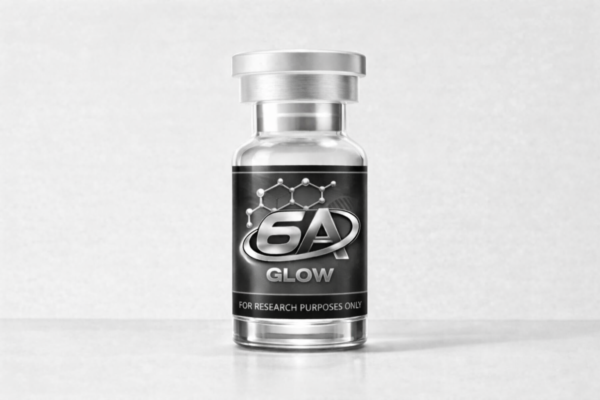
GLOW is a three-peptide research blend containing BPC-157 10mg, TB-500 10mg, and GHK-Cu 50mg per vial. The 70mg formulation is designed for controlled laboratory research involving peptide signaling, cellular biology, extracellular matrix processes, and tissue-repair research.
GLOW Peptide Blend is a multi-peptide research formulation combining three distinct compounds frequently investigated in regenerative biology and cellular research: BPC-157, TB-500, and GHK-Cu. The formulation brings these three research peptides together in a single vial, allowing researchers to investigate their individual characteristics and potential interactions within controlled experimental models.
Each component represents a different area of peptide research. BPC-157 is a synthetic pentadecapeptide that has primarily been investigated in preclinical models involving cellular signaling, vascular processes, and tissue-repair biology. TB-500 is a synthetic peptide associated with the actin-binding region of thymosin beta-4 and has been studied in relation to cell migration and cytoskeletal processes. GHK-Cu is a copper-binding tripeptide that has been investigated extensively in relation to extracellular matrix biology, collagen-related processes, cellular signaling, and skin research.
The GLOW formulation combines these three research areas into one defined composition. BPC-157 and TB-500 are each supplied at 10 mg, while GHK-Cu is supplied at 50 mg, resulting in 70 mg of total peptide material per vial.
GLOW Composition
The formulation contains:
BPC-157 — 10 mg
TB-500 — 10 mg
GHK-Cu — 50 mg
Total peptide content — 70 mg per vial
This 50/10/10 formulation is commonly used as a GLOW-style research blend. It should be understood as a product formulation rather than an established therapeutic or clinical dosing protocol. No controlled clinical trial has established the efficacy or safety of the three-peptide combination as a single formulation.
BPC-157 Research Component
BPC-157, also known as Body Protection Compound-157, is a synthetic pentadecapeptide that has received substantial attention in preclinical peptide research.
Laboratory investigations have examined BPC-157 in experimental models involving vascular signaling, cellular responses, connective-tissue biology, and gastrointestinal research. Much of the available evidence comes from animal and laboratory studies, so findings from these models should not automatically be interpreted as evidence of human therapeutic effects.
Within the GLOW formulation, BPC-157 provides researchers with a peptide component for investigating cellular and vascular signaling pathways alongside the other constituents.
TB-500 Research Component
TB-500 is commonly described as a synthetic peptide fragment associated with the biological research surrounding thymosin beta-4.
Thymosin beta-4 is an actin-binding protein involved in cellular processes including cytoskeletal organization and cell migration. Research involving TB-500 and related thymosin-beta-4 biology has therefore focused on cellular movement, tissue organization, and experimental repair processes.
An important distinction should be maintained between TB-500 and full-length thymosin beta-4. Research findings involving the parent protein should not automatically be presented as evidence for the commercial TB-500 fragment itself.
GHK-Cu Research Component
GHK-Cu, or copper tripeptide, is a copper-associated form of the naturally occurring tripeptide glycyl-L-histidyl-L-lysine.
GHK-Cu has been studied extensively in cellular and dermatological research. Investigations have examined its relationship with collagen production, extracellular matrix processes, skin biology, oxidative mechanisms, and cellular signaling.
Because GHK-Cu represents a different research pathway from BPC-157 and TB-500, its inclusion gives the GLOW formulation a broader research profile involving extracellular matrix and copper-peptide biology.
Why Combine These Three Peptides?
The GLOW formulation is based on the idea that each peptide can be studied in a different biological context.
BPC-157 has been investigated primarily in relation to vascular and cellular signaling. TB-500 is associated with research into actin-related cellular organization and migration. GHK-Cu has been studied extensively in extracellular matrix and collagen-related research.
This creates a research formulation that allows scientists to investigate multiple peptide-associated pathways within a single experimental material.
However, the theoretical complementarity of these mechanisms should not be confused with demonstrated synergy. The individual peptides have separate research literatures, while dedicated research on the GLOW combination itself remains limited.
Research Applications
GLOW may be investigated in controlled laboratory studies involving:
Peptide signaling research
Cellular biology
Tissue-repair models
Extracellular matrix research
Collagen-related research
Cell migration studies
Cytoskeletal research
Vascular signaling research
Regenerative biology
Dermatological research
Peptide structure-function studies
Molecular biology
Experimental wound-healing models
Cellular stress research
Researchers can select appropriate experimental systems depending on the specific biological question being studied. Cellular assays, biochemical techniques, microscopy, molecular analysis, and other validated methodologies may be used to investigate individual components or the combined formulation.
GLOW and Regenerative Research
Regenerative biology involves numerous interconnected processes. Cells must communicate with one another, migrate appropriately, interact with the extracellular matrix, and respond to local biochemical signals.
The three components of GLOW are studied in different areas of this broader research field. GHK-Cu has been examined in relation to extracellular matrix and collagen biology, while BPC-157 and TB-500 have primarily attracted preclinical interest involving cellular, vascular, and tissue-repair processes.
By placing these compounds into a single research formulation, GLOW provides researchers with a convenient material for studying multi-peptide experimental systems.
Importantly, the formulation itself should be evaluated independently. Results obtained from studies of an individual component cannot simply be transferred to the complete GLOW blend.
Product Format
GLOW is supplied as a multi-peptide research formulation containing a total of 70 mg of peptide material per vial.
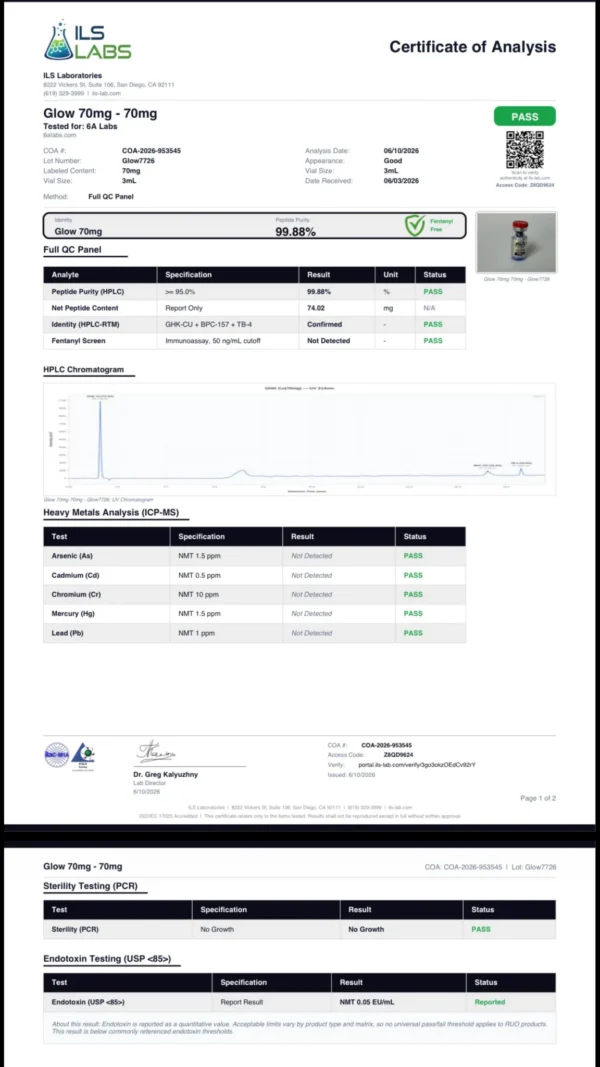
The material should be evaluated according to the specific batch documentation supplied with the product. Where applicable, researchers should use appropriate analytical methods to verify identity, purity, and composition.
Quality and Analytical Research
Quality control is particularly important when multiple peptide components are incorporated into one formulation.
Researchers may use appropriate analytical techniques to characterize the material and confirm relevant product attributes. Depending on the research requirements, chromatographic and mass-spectrometric methods may be used to evaluate peptide identity and purity.
Maintaining accurate lot records also helps researchers improve reproducibility. Experimental documentation should include relevant information about the material, storage conditions, preparation procedures, experimental parameters, and analytical observations.
GLOW Peptide Blend Laboratory Handling and Storage
GLOW should be handled according to the specific product documentation and batch Certificate of Analysis.
Researchers should minimize unnecessary exposure to unfavorable environmental conditions and follow established laboratory procedures for peptide research materials. Storage requirements may vary according to the formulation and packaging, so the product-specific instructions should take precedence over generic peptide-storage recommendations.
Once a research material has been prepared for an experiment, appropriate laboratory handling procedures should be followed. Researchers should also document preparation conditions and experimental variables to support reproducibility.
Product Specifications
Specification
Details
Product Name
GLOW Peptide Blend
BPC-157
10 mg
TB-500
10 mg
GHK-Cu
50 mg
Total Peptide Content
70 mg
Formulation
Multi-Peptide Research Blend
Application
Laboratory Research
Research Areas
Cellular, peptide, regenerative, and molecular research
Research Considerations
The three constituents should not be treated as interchangeable compounds. Each has a distinct molecular structure and research history.
Similarly, research findings concerning individual peptides do not establish the safety, efficacy, or activity of the complete GLOW formulation. The blend should be investigated as its own experimental material when researchers are evaluating combination effects.
This distinction is especially important because the available literature for BPC-157, TB-500-related research, and GHK-Cu differs substantially in terms of experimental models and evidence quality.
Important Research Disclaimer of GLOW Peptide Blend
GLOW Peptide Blend is intended strictly for laboratory and research purposes. It is not intended for human consumption, self-administration, veterinary use, diagnosis, treatment, mitigation, or prevention of any disease or medical condition. This product should only be handled and studied by appropriately qualified personnel in accordance with applicable laboratory procedures, institutional requirements, and relevant regulations.
GLOW Peptide Blend for Laboratory Research
GLOW Peptide Blend combines BPC-157 10 mg, TB-500 10 mg, and GHK-Cu 50 mg into a single 70 mg research formulation. By incorporating three distinct peptide research materials, the formulation provides researchers with a convenient platform for investigating cellular signaling, extracellular matrix biology, cell migration, peptide interactions, and regenerative research models.
Its value as a research material comes from the distinct characteristics of its individual components. Rather than assuming that the combination produces a particular biological outcome, researchers can evaluate the formulation under controlled experimental conditions and determine how the combined material behaves within their specific research model.
Reviews
There are no reviews yet.
Be the first to review “GLOW Peptide Blend – BPC-157 10mg + TB-500 10mg + GHK-Cu 50mg”Cancel Reply

Reviews
There are no reviews yet.